My Arsenal FC
A blog about all things Arsenal
Arsenal Player Analysis: Premier League Match Day 29 Team Selection
Following Arsenal’s victory versus Porto, attention turns to Arsenal’s Premier League clash versus Manchester Coty and which 11 available players make up Arsenal’s most productive team for the match.
To do this, we need to look at the on-field production and the comparative ranking of each player which comprises Arsenal’s senior squad, and Arsenal’s ideal tactical approach.
Methodology
In assessing the on-field production and the comparative ranking of each player which comprise Arsenal’s senior squad, each player is allocated into nine positional categories (with some players allocated to multiple positional categories due to their perceived versatility).
Those positional categories consist of:
- Goalkeeper
- Right Fullback
- Centre Back
- Left Fullback
- Defensive Midfield
- Central Midfield
- Right Forward
- Centre Forward
- Left Forward
Once categorised, each player’s output in defined key performance indicators (KPIs) for their respective positional category has then been considered, using data sourced from Whoscored.com.
To provide a realistic picture of each individual player’s on-field production, only data from those seasons, throughout the player’s professional career, where the player has started at least 19 league games in at least two seasons (consecutive or non-consecutive) in Europe’s top 5 leagues was considered. Where a player has not met that criteria, their productivity data was not assessed.
The KPI data considered for each positional group is based on the assumption that Arsenal adopt a 4-1-2-3 formation and the cornerstones of Arsenal’s tactical approach is as follows:
- Defending by the fullbacks, centre midfielders, and forwards pressing the opposition in their own half, with the centre backs and defensive midfielder containing the opposition in the event they break the press.
- Attacking through a combination of:
- counter pressing; and
- the fullbacks, centre backs and defensive midfielder passing the ball amongst themselves using one or two touches, until one of the central midfielders is free between the opposition’s midfield and defensive lines to play in one of the three forwards making off the ball runs on goal.
- The goalkeeper’s primary aims are to stop shots and claim crosses.
- The fullbacks’ primary aim is to contribute to the press by tackling their opponent (2+ per match) and making interceptions (2+ per match) to recover the ball.
- The centre backs’ primary aim is to shield the goalkeeper by positioning themselves to intercept balls (2+ per game), tackle their opponent (2+ per game) and win aerial duels (3+ per game).
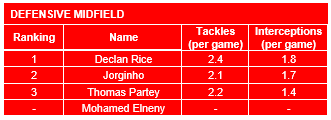
- The defensive midfielder’s primary aim is to shield the centre backs by tackling their opponent (2+ per match) and making interceptions (2+ per match) to recover the ball.
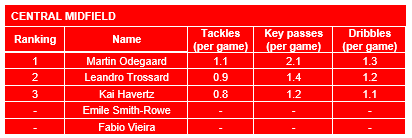
- The centre midfielders’ primary aims are to contribute to the press by tackling their opponent (2+ per game) and contribute to the team’s offensive play through key passes (1+ per game) and attacking dribbles (1+ per game).
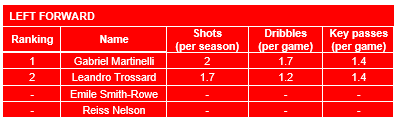
- The wide forwards’ primary aim is to contribute to the team’s offensive play through attacking dribbles (1+ per match), key passes (1+ per game) and shots (3+ per game).
- The centre forward’s primary aim is to contribute to the team’s offensive play through shots (3+ per game), key passes (1+ per game) and successful aerial duels (3+ per game).
The player rankings by position are as follows:




Formation and line-up
Based on:
- the above analytical comparison,
- Arsenal’s aforementioned tactical basis and minimum required KPIs,
- the need to rotate players to maximise playing intensity and minimise injuries, and
- Timber, Martinelli and Saka recovering from injury,
the 11 players which should comprise Arsenal’s starting 11, for their Premier League clash vs Manchester City would appear to be as follows:

Freddie08
Arsenal Player Analysis: Premier League Match Day 14 Team Selection
Following Arsenal’s victory versus Lens, attention turns to Arsenal’s Premier League clash versus Wolverhampton Wolves and which 11 available players make up Arsenal’s most productive team for the match.
To do this, we need to look at the on-field production and the comparative ranking of each player which comprises Arsenal’s senior squad, and Arsenal’s ideal tactical approach.
Methodology
In assessing the on-field production and the comparative ranking of each player which comprise Arsenal’s senior squad, each player is allocated into nine positional categories (with some players allocated to multiple positional categories due to their perceived versatility).
Those positional categories consist of:
- Goalkeeper
- Right Fullback
- Centre Back
- Left Fullback
- Defensive Midfield
- Central Midfield
- Right Forward
- Centre Forward
- Left Forward
Once categorised, each player’s output in defined key performance indicators (KPIs) for their respective positional category has then been considered, using data sourced from Whoscored.com.
To provide a realistic picture of each individual player’s on-field production, only data from those seasons, throughout the player’s professional career, where the player has started at least 19 league games in at least two seasons (consecutive or non-consecutive) in Europe’s top 5 leagues was considered. Where a player has not met that criteria, their productivity data was not assessed.
The KPI data considered for each positional group is based on the assumption that Arsenal adopt a 4-1-2-3 formation and the cornerstones of Arsenal’s tactical approach is as follows:
- Defending by the fullbacks, centre midfielders, and forwards pressing the opposition in their own half, with the centre backs and defensive midfielder containing the opposition in the event they break the press.
- Attacking through a combination of:
- counter pressing; and
- the fullbacks, centre backs and defensive midfielder passing the ball amongst themselves using one or two touches, until one of the central midfielders is free between the opposition’s midfield and defensive lines to play in one of the three forwards making off the ball runs on goal.
- The goalkeeper’s primary aims are to stop shots and claim crosses.
- The fullbacks’ primary aim is to contribute to the press by tackling their opponent (2+ per match) and making interceptions (2+ per match) to recover the ball.
- The centre backs’ primary aim is to shield the goalkeeper by positioning themselves to intercept balls (2+ per game), tackle their opponent (2+ per game) and win aerial duels (3+ per game).
- The defensive midfielder’s primary aim is to shield the centre backs by tackling their opponent (2+ per match) and making interceptions (2+ per match) to recover the ball.
- The centre midfielders’ primary aims are to contribute to the press by tackling their opponent (2+ per game) and contribute to the team’s offensive play through key passes (1+ per game) and attacking dribbles (1+ per game).
- The wide forwards’ primary aim is to contribute to the team’s offensive play through attacking dribbles (1+ per match), key passes (1+ per game) and shots (3+ per game).
- The centre forward’s primary aim is to contribute to the team’s offensive play through shots (3+ per game), key passes (1+ per game) and successful aerial duels (3+ per game).
The player rankings by position are as follows:
Formation and line-up
Based on:
- the above analytical comparison,
- Arsenal’s aforementioned tactical basis and minimum required KPIs,
- the need to rotate players to maximise playing intensity and minimise injuries, and
- Timber, Partey, Smith-Rowe and Vieira recovering from injury,
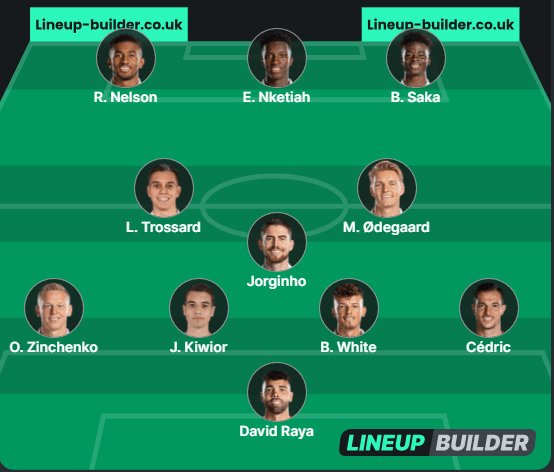
the 11 players which should comprise Arsenal’s starting 11, for their Premier League clash vs Wolves would appear to be as follows:
Freddie08
Arsenal Player Analysis: Champions League Match Day 5 Team Selection
Following Arsenal’s victory versus Brentford, attention turns to Arsenal’s Champions League clash versus Lens and which 11 available players make up Arsenal’s most productive team for the match.
To do this, we need to look at the on-field production and the comparative ranking of each player which comprises Arsenal’s senior squad, and Arsenal’s ideal tactical approach.
Methodology
In assessing the on-field production and the comparative ranking of each player which comprise Arsenal’s senior squad, each player is allocated into nine positional categories (with some players allocated to multiple positional categories due to their perceived versatility).
Those positional categories consist of:
- Goalkeeper
- Right Fullback
- Centre Back
- Left Fullback
- Defensive Midfield
- Central Midfield
- Right Forward
- Centre Forward
- Left Forward
Once categorised, each player’s output in defined key performance indicators (KPIs) for their respective positional category has then been considered, using data sourced from Whoscored.com.
To provide a realistic picture of each individual player’s on-field production, only data from those seasons, throughout the player’s professional career, where the player has started at least 19 league games in at least two seasons (consecutive or non-consecutive) in Europe’s top 5 leagues was considered. Where a player has not met that criteria, their productivity data was not assessed.
The KPI data considered for each positional group is based on the assumption that Arsenal adopt a 4-1-2-3 formation and the cornerstones of Arsenal’s tactical approach is as follows:
- Defending by the fullbacks, centre midfielders, and forwards pressing the opposition in their own half, with the centre backs and defensive midfielder containing the opposition in the event they break the press.
- Attacking through a combination of:
- counter pressing; and
- the fullbacks, centre backs and defensive midfielder passing the ball amongst themselves using one or two touches, until one of the central midfielders is free between the opposition’s midfield and defensive lines to play in one of the three forwards making off the ball runs on goal.
- The goalkeeper’s primary aims are to stop shots and claim crosses.
- The fullbacks’ primary aim is to contribute to the press by tackling their opponent (2+ per match) and making interceptions (2+ per match) to recover the ball.
- The centre backs’ primary aim is to shield the goalkeeper by positioning themselves to intercept balls (2+ per game), tackle their opponent (2+ per game) and win aerial duels (3+ per game).
- The defensive midfielder’s primary aim is to shield the centre backs by tackling their opponent (2+ per match) and making interceptions (2+ per match) to recover the ball.
- The centre midfielders’ primary aims are to contribute to the press by tackling their opponent (2+ per game) and contribute to the team’s offensive play through key passes (1+ per game) and attacking dribbles (1+ per game).
- The wide forwards’ primary aim is to contribute to the team’s offensive play through attacking dribbles (1+ per match), key passes (1+ per game) and shots (3+ per game).
- The centre forward’s primary aim is to contribute to the team’s offensive play through shots (3+ per game), key passes (1+ per game) and successful aerial duels (3+ per game).
The player rankings by position are as follows:
Formation and line-up
Based on:
- the above analytical comparison,
- Arsenal’s aforementioned tactical basis and minimum required KPIs,
- the need to rotate players to maximise playing intensity and minimise injuries, and
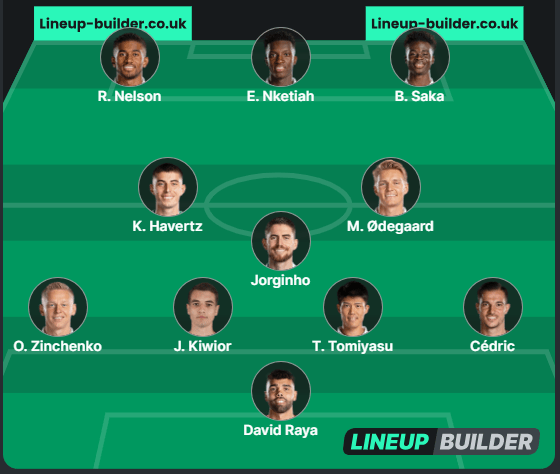
- White, Timber, Partey, Smith-Rowe and Vieira recovering from injury,
the 11 players which should comprise Arsenal’s starting 11, for their Champions League clash vs Lens would appear to be as follows:
Freddie08
Arsenal Player Analysis: Premier League Round 13 Team Selection
Following Arsenal’s victory versus Burnley, attention turns to Arsenal’s Premier League clash versus Brentford and which 11 available players make up Arsenal’s most productive team for the match.
To do this, we need to look at the on-field production and the comparative ranking of each player which comprises Arsenal’s senior squad, and Arsenal’s ideal tactical approach.
Methodology
In assessing the on-field production and the comparative ranking of each player which comprise Arsenal’s senior squad, each player is allocated into nine positional categories (with some players allocated to multiple positional categories due to their perceived versatility).
Those positional categories consist of:
- Goalkeeper
- Right Fullback
- Centre Back
- Left Fullback
- Defensive Midfield
- Central Midfield
- Right Forward
- Centre Forward
- Left Forward
Once categorised, each player’s output in defined key performance indicators (KPIs) for their respective positional category has then been considered, using data sourced from Whoscored.com.
To provide a realistic picture of each individual player’s on-field production, only data from those seasons, throughout the player’s professional career, where the player has started at least 19 league games in at least two seasons (consecutive or non-consecutive) in Europe’s top 5 leagues was considered. Where a player has not met that criteria, their productivity data was not assessed.
The KPI data considered for each positional group is based on the assumption that Arsenal adopt a 4-1-2-3 formation and the cornerstones of Arsenal’s tactical approach is as follows:
- Defending by the fullbacks, centre midfielders, and forwards pressing the opposition in their own half, with the centre backs and defensive midfielder containing the opposition in the event they break the press.
- Attacking through a combination of:
- counter pressing; and
- the fullbacks, centre backs and defensive midfielder passing the ball amongst themselves using one or two touches, until one of the central midfielders is free between the opposition’s midfield and defensive lines to play in one of the three forwards making off the ball runs on goal.
- The goalkeeper’s primary aims are to stop shots and claim crosses.
- The fullbacks’ primary aim is to contribute to the press by tackling their opponent (2+ per match) and making interceptions (2+ per match) to recover the ball.
- The centre backs’ primary aim is to shield the goalkeeper by positioning themselves to intercept balls (2+ per game), tackle their opponent (2+ per game) and win aerial duels (3+ per game).
- The defensive midfielder’s primary aim is to shield the centre backs by tackling their opponent (2+ per match) and making interceptions (2+ per match) to recover the ball.
- The centre midfielders’ primary aims are to contribute to the press by tackling their opponent (2+ per game) and contribute to the team’s offensive play through key passes (1+ per game) and attacking dribbles (1+ per game).
- The wide forwards’ primary aim is to contribute to the team’s offensive play through attacking dribbles (1+ per match), key passes (1+ per game) and shots (3+ per game).
- The centre forward’s primary aim is to contribute to the team’s offensive play through shots (3+ per game), key passes (1+ per game) and successful aerial duels (3+ per game).
The player rankings by position are as follows:
Formation and line-up
Based on:
- the above analytical comparison,
- Arsenal’s aforementioned tactical basis and minimum required KPIs,
- the need to rotate players to maximise playing intensity and minimise injuries, and
- White, Timber, Partey, Smith-Rowe and Nketiah recovering from injury, Raya ineligible and Vieira suspended,
the 11 players which should comprise Arsenal’s starting 11, for their Premier League clash vs Brentford would appear to be as follows:

Freddie08
Arsenal Player Analysis: Premier League Round 12 Team Selection
Following Arsenal’s victory versus Sevilla, attention turns to Arsenal’s Premier League clash versus Burnley and which 11 available players make up Arsenal’s most productive team for the match.
To do this, we need to look at the on-field production and the comparative ranking of each player which comprises Arsenal’s senior squad, and Arsenal’s ideal tactical approach.
Methodology
In assessing the on-field production and the comparative ranking of each player which comprise Arsenal’s senior squad, each player is allocated into nine positional categories (with some players allocated to multiple positional categories due to their perceived versatility).
Those positional categories consist of:
- Goalkeeper
- Right Fullback
- Centre Back
- Left Fullback
- Defensive Midfield
- Central Midfield
- Right Forward
- Centre Forward
- Left Forward
Once categorised, each player’s output in defined key performance indicators (KPIs) for their respective positional category has then been considered, using data sourced from Whoscored.com.
To provide a realistic picture of each individual player’s on-field production, only data from those seasons, throughout the player’s professional career, where the player has started at least 19 league games in at least two seasons (consecutive or non-consecutive) in Europe’s top 5 leagues was considered. Where a player has not met that criteria, their productivity data was not assessed.
The KPI data considered for each positional group is based on the assumption that Arsenal adopt a 4-1-2-3 formation and the cornerstones of Arsenal’s tactical approach is as follows:
- Defending by the fullbacks, centre midfielders, and forwards pressing the opposition in their own half, with the centre backs and defensive midfielder containing the opposition in the event they break the press.
- Attacking through a combination of:
- counter pressing; and
- the fullbacks, centre backs and defensive midfielder passing the ball amongst themselves using one or two touches, until one of the central midfielders is free between the opposition’s midfield and defensive lines to play in one of the three forwards making off the ball runs on goal.
- The goalkeeper’s primary aims are to stop shots and claim crosses.
- The fullbacks’ primary aim is to contribute to the press by tackling their opponent (2+ per match) and making interceptions (2+ per match) to recover the ball.
- The centre backs’ primary aim is to shield the goalkeeper by positioning themselves to intercept balls (2+ per game), tackle their opponent (2+ per game) and win aerial duels (3+ per game).
- The defensive midfielder’s primary aim is to shield the centre backs by tackling their opponent (2+ per match) and making interceptions (2+ per match) to recover the ball.
- The centre midfielders’ primary aims are to contribute to the press by tackling their opponent (2+ per game) and contribute to the team’s offensive play through key passes (1+ per game) and attacking dribbles (1+ per game).
- The wide forwards’ primary aim is to contribute to the team’s offensive play through attacking dribbles (1+ per match), key passes (1+ per game) and shots (3+ per game).
- The centre forward’s primary aim is to contribute to the team’s offensive play through shots (3+ per game), key passes (1+ per game) and successful aerial duels (3+ per game).
The player rankings by position are as follows:
Formation and line-up
Based on:
- the above analytical comparison,
- Arsenal’s aforementioned tactical basis and minimum required KPIs,
- the need to rotate players to maximise playing intensity and minimise injuries, and
- Timber, Partey, Smith-Rowe, Odegaard, Nketiah, and Jesus recovering from injury,
the 11 players which should comprise Arsenal’s starting 11, for their Premier League clash vs Burnley would appear to be as follows:

Freddie08
Arsenal Player Analysis: Champions League Team Selection
Following Arsenal’s disappointing loss versus Newcastle, attention turns to Arsenal’s Champions League clash versus Sevilla and which 11 available players make up Arsenal’s most productive team for the match.
To do this, we need to look at the on-field production and the comparative ranking of each player which comprises Arsenal’s senior squad, and Arsenal’s ideal tactical approach.
Methodology
In assessing the on-field production and the comparative ranking of each player which comprise Arsenal’s senior squad, each player is allocated into nine positional categories (with some players allocated to multiple positional categories due to their perceived versatility).
Those positional categories consist of:
- Goalkeeper
- Right Fullback
- Centre Back
- Left Fullback
- Defensive Midfield
- Central Midfield
- Right Forward
- Centre Forward
- Left Forward
Once categorised, each player’s output in defined key performance indicators (KPIs) for their respective positional category has then been considered, using data sourced from Whoscored.com.
To provide a realistic picture of each individual player’s on-field production, only data from those seasons, throughout the player’s professional career, where the player has started at least 19 league games in at least two seasons (consecutive or non-consecutive) in Europe’s top 5 leagues was considered. Where a player has not met that criteria, their productivity data was not assessed.
The KPI data considered for each positional group is based on the assumption that Arsenal adopt a 4-1-2-3 formation and the cornerstones of Arsenal’s tactical approach is as follows:
- Defending by the fullbacks, centre midfielders, and forwards pressing the opposition in their own half, with the centre backs and defensive midfielder containing the opposition in the event they break the press.
- Attacking through a combination of:
- counter pressing; and
- the fullbacks, centre backs and defensive midfielder passing the ball amongst themselves using one or two touches, until one of the central midfielders is free between the opposition’s midfield and defensive lines to play in one of the three forwards making off the ball runs on goal.
- The goalkeeper’s primary aims are to stop shots and claim crosses.
- The fullbacks’ primary aim is to contribute to the press by tackling their opponent (2+ per match) and making interceptions (2+ per match) to recover the ball.
- The centre backs’ primary aim is to shield the goalkeeper by positioning themselves to intercept balls (2+ per game), tackle their opponent (2+ per game) and win aerial duels (3+ per game).
- The defensive midfielder’s primary aim is to shield the centre backs by tackling their opponent (2+ per match) and making interceptions (2+ per match) to recover the ball.
- The centre midfielders’ primary aims are to contribute to the press by tackling their opponent (2+ per game) and contribute to the team’s offensive play through key passes (1+ per game) and attacking dribbles (1+ per game).
- The wide forwards’ primary aim is to contribute to the team’s offensive play through attacking dribbles (1+ per match), key passes (1+ per game) and shots (3+ per game).
- The centre forward’s primary aim is to contribute to the team’s offensive play through shots (3+ per game), key passes (1+ per game) and successful aerial duels (3+ per game).
The player rankings by position are as follows:
Formation and line-up
Based on:
- the above analytical comparison,
- Arsenal’s aforementioned tactical basis and minimum required KPIs,
- the need to rotate players to maximise playing intensity and minimise injuries, and
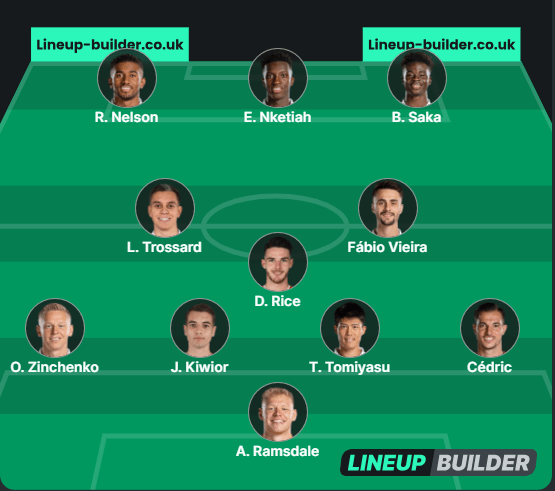
- Timber, Partey, Smith-Rowe, Odegaard and Jesus recovering from injury,
the 11 players which should comprise Arsenal’s starting 11, for their Champions League clash vs Sevilla would appear to be as follows:
Freddie08
Arsenal Player Analysis: Premier League Round 11 Team Selection
Following Arsenal’s disappointing loss versus West Ham, attention turns to Arsenal’s Premier League clash versus Newcastle and which 11 available players make up Arsenal’s most productive team for the match.
To do this, we need to look at the on-field production and the comparative ranking of each player which comprises Arsenal’s senior squad, and Arsenal’s ideal tactical approach.
Methodology
In assessing the on-field production and the comparative ranking of each player which comprise Arsenal’s senior squad, each player is allocated into nine positional categories (with some players allocated to multiple positional categories due to their perceived versatility).
Those positional categories consist of:
- Goalkeeper
- Right Fullback
- Centre Back
- Left Fullback
- Defensive Midfield
- Central Midfield
- Right Forward
- Centre Forward
- Left Forward
Once categorised, each player’s output in defined key performance indicators (KPIs) for their respective positional category has then been considered, using data sourced from Whoscored.com.
To provide a realistic picture of each individual player’s on-field production, only data from those seasons, throughout the player’s professional career, where the player has started at least 19 league games in at least two seasons (consecutive or non-consecutive) in Europe’s top 5 leagues was considered. Where a player has not met that criteria, their productivity data was not assessed.
The KPI data considered for each positional group is based on the assumption that Arsenal adopt a 4-1-2-3 formation and the cornerstones of Arsenal’s tactical approach is as follows:
- Defending by the fullbacks, centre midfielders, and forwards pressing the opposition in their own half, with the centre backs and defensive midfielder containing the opposition in the event they break the press.
- Attacking through a combination of:
- counter pressing; and
- the fullbacks, centre backs and defensive midfielder passing the ball amongst themselves using one or two touches, until one of the central midfielders is free between the opposition’s midfield and defensive lines to play in one of the three forwards making off the ball runs on goal.
- The goalkeeper’s primary aims are to stop shots and claim crosses.
- The fullbacks’ primary aim is to contribute to the press by tackling their opponent (2+ per match) and making interceptions (2+ per match) to recover the ball.
- The centre backs’ primary aim is to shield the goalkeeper by positioning themselves to intercept balls (2+ per game), tackle their opponent (2+ per game) and win aerial duels (3+ per game).
- The defensive midfielder’s primary aim is to shield the centre backs by tackling their opponent (2+ per match) and making interceptions (2+ per match) to recover the ball.
- The centre midfielders’ primary aims are to contribute to the press by tackling their opponent (2+ per game) and contribute to the team’s offensive play through key passes (1+ per game) and attacking dribbles (1+ per game).
- The wide forwards’ primary aim is to contribute to the team’s offensive play through attacking dribbles (1+ per match), key passes (1+ per game) and shots (3+ per game).
- The centre forward’s primary aim is to contribute to the team’s offensive play through shots (3+ per game), key passes (1+ per game) and successful aerial duels (3+ per game).
The player rankings by position are as follows:
Formation and line-up
Based on:
- the above analytical comparison,
- Arsenal’s aforementioned tactical basis and minimum required KPIs,
- the need to rotate players to maximise playing intensity and minimise injuries, and
- Timber, Partey, Smith-Rowe and Jesus recovering from injury,
the 11 players which should comprise Arsenal’s starting 11, for their Premier League clash vs Newcastle would appear to be as follows:

Freddie08
Arsenal Player Analysis: EFL Cup Team Selection
Following Arsenal’s hard fought victory versus Sevilla, attention turns to Arsenal’s EFL Cup clash versus West Ham United and which 11 available players make up Arsenal’s most productive team for the match.
To do this, we need to look at the on-field production and the comparative ranking of each player which comprises Arsenal’s senior squad, and Arsenal’s ideal tactical approach.
Methodology
In assessing the on-field production and the comparative ranking of each player which comprise Arsenal’s senior squad, each player is allocated into nine positional categories (with some players allocated to multiple positional categories due to their perceived versatility).
Those positional categories consist of:
- Goalkeeper
- Right Fullback
- Centre Back
- Left Fullback
- Defensive Midfield
- Central Midfield
- Right Forward
- Centre Forward
- Left Forward
Once categorised, each player’s output in defined key performance indicators (KPIs) for their respective positional category has then been considered, using data sourced from Whoscored.com.
To provide a realistic picture of each individual player’s on-field production, only data from those seasons, throughout the player’s professional career, where the player has started at least 19 league games in at least two seasons (consecutive or non-consecutive) in Europe’s top 5 leagues was considered. Where a player has not met that criteria, their productivity data was not assessed.
The KPI data considered for each positional group is based on the assumption that Arsenal adopt a 4-1-2-3 formation and the cornerstones of Arsenal’s tactical approach is as follows:
- Defending by the fullbacks, centre midfielders, and forwards pressing the opposition in their own half, with the centre backs and defensive midfielder containing the opposition in the event they break the press.
- Attacking through a combination of:
- counter pressing; and
- the fullbacks, centre backs and defensive midfielder passing the ball amongst themselves using one or two touches, until one of the central midfielders is free between the opposition’s midfield and defensive lines to play in one of the three forwards making off the ball runs on goal.
- The goalkeeper’s primary aims are to stop shots and claim crosses.
- The fullbacks’ primary aim is to contribute to the press by tackling their opponent (2+ per match) and making interceptions (2+ per match) to recover the ball.
- The centre backs’ primary aim is to shield the goalkeeper by positioning themselves to intercept balls (2+ per game), tackle their opponent (2+ per game) and win aerial duels (3+ per game).
- The defensive midfielder’s primary aim is to shield the centre backs by tackling their opponent (2+ per match) and making interceptions (2+ per match) to recover the ball.
- The centre midfielders’ primary aims are to contribute to the press by tackling their opponent (2+ per game) and contribute to the team’s offensive play through key passes (1+ per game) and attacking dribbles (1+ per game).
- The wide forwards’ primary aim is to contribute to the team’s offensive play through attacking dribbles (1+ per match), key passes (1+ per game) and shots (3+ per game).
- The centre forward’s primary aim is to contribute to the team’s offensive play through shots (3+ per game), key passes (1+ per game) and successful aerial duels (3+ per game).
The player rankings by position are as follows:
Formation and line-up
Based on:
- the above analytical comparison,
- Arsenal’s aforementioned tactical basis and minimum required KPIs,
- the need to rotate players to maximise playing intensity and minimise injuries, and
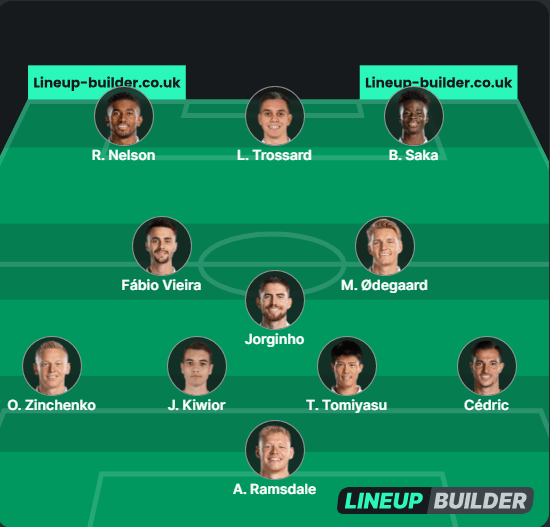
- Timber, Partey and Jesus recovering from injury,
the 11 players which should comprise Arsenal’s starting 11, for their Premier League clash vs West Ham United would appear to be as follows:
Freddie08
Arsenal Player Analysis: Premier League Round 10 Team Selection
Following Arsenal’s hard fought victory versus Sevilla, attention turns to Arsenal’s Premier League clash versus Sheffield United, and which 11 available players make up Arsenal’s most productive team for the match.
To do this, we need to look at the on-field production and the comparative ranking of each player which comprises Arsenal’s senior squad, and Arsenal’s ideal tactical approach.
Methodology
In assessing the on-field production and the comparative ranking of each player which comprise Arsenal’s senior squad, each player is allocated into nine positional categories (with some players allocated to multiple positional categories due to their perceived versatility).
Those positional categories consist of:
- Goalkeeper
- Right Fullback
- Centre Back
- Left Fullback
- Defensive Midfield
- Central Midfield
- Right Forward
- Centre Forward
- Left Forward
Once categorised, each player’s output in defined key performance indicators (KPIs) for their respective positional category has then been considered, using data sourced from Whoscored.com.
To provide a realistic picture of each individual player’s on-field production, only data from those seasons, throughout the player’s professional career, where the player has started at least 19 league games in at least two seasons (consecutive or non-consecutive) in Europe’s top 5 leagues was considered. Where a player has not met that criteria, their productivity data was not assessed.
The KPI data considered for each positional group is based on the assumption that Arsenal adopt a 4-1-2-3 formation and the cornerstones of Arsenal’s tactical approach is as follows:
- Defending by the fullbacks, centre midfielders, and forwards pressing the opposition in their own half, with the centre backs and defensive midfielder containing the opposition in the event they break the press.
- Attacking through a combination of:
- counter pressing; and
- the fullbacks, centre backs and defensive midfielder passing the ball amongst themselves using one or two touches, until one of the central midfielders is free between the opposition’s midfield and defensive lines to play in one of the three forwards making off the ball runs on goal.
- The goalkeeper’s primary aims are to stop shots and claim crosses.
- The fullbacks’ primary aim is to contribute to the press by tackling their opponent (2+ per match) and making interceptions (2+ per match) to recover the ball.
- The centre backs’ primary aim is to shield the goalkeeper by positioning themselves to intercept balls (2+ per game), tackle their opponent (2+ per game) and win aerial duels (3+ per game).
- The defensive midfielder’s primary aim is to shield the centre backs by tackling their opponent (2+ per match) and making interceptions (2+ per match) to recover the ball.
- The centre midfielders’ primary aims are to contribute to the press by tackling their opponent (2+ per game) and contribute to the team’s offensive play through key passes (1+ per game) and attacking dribbles (1+ per game).
- The wide forwards’ primary aim is to contribute to the team’s offensive play through attacking dribbles (1+ per match), key passes (1+ per game) and shots (3+ per game).
- The centre forward’s primary aim is to contribute to the team’s offensive play through shots (3+ per game), key passes (1+ per game) and successful aerial duels (3+ per game).
The player rankings by position are as follows:
Formation and line-up
Based on:
- the above analytical comparison,
- Arsenal’s aforementioned tactical basis and minimum required KPIs,
- the need to rotate players to maximise playing intensity and minimise injuries, and
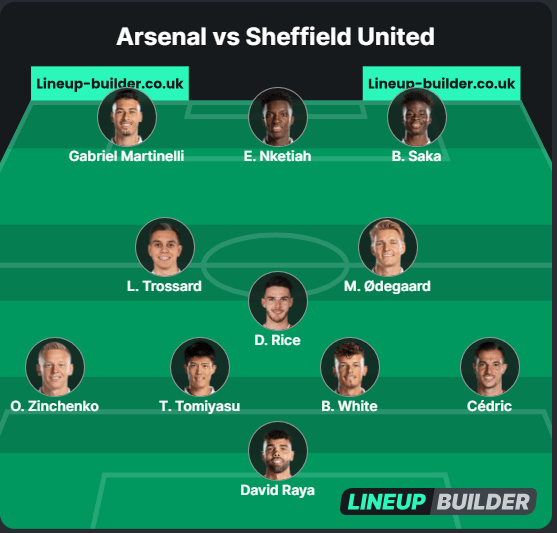
- Timber, Partey and Jesus recovering from injury,
the 11 players which should comprise Arsenal’s starting 11, for their Premier League clash vs Sheffield United would appear to be as follows:
Freddie08
Arsenal Player Analysis: Premier League Round 2 Team Selection
Following Arsenal’s scrappy victory versus Nottingham Forrest, attention turns to Arsenal’s Premier League clash versus Crystal Palace, and which 11 available players make up Arsenal’s most productive team for the match.
To do this, we need to look at the on-field production and the comparative ranking of each player which comprises Arsenal’s senior squad, and Arsenal’s ideal tactical approach.
Methodology
In assessing the on-field production and the comparative ranking of each player which comprise Arsenal’s senior squad, each player is allocated into seven positional categories (with some players allocated to multiple positional categories due to their perceived versatility).
Those positional categories consist of:
- Goalkeeper
- Central Defender
- Defensive Midfielder
- Central Midfielder
- Right Forward
- Centre Forward
- Left Forward
Once categorised, each player’s output in defined key performance indicators (KPIs) for their respective positional category has then been considered, using data sourced from Whoscored.com.
To provide a realistic picture of each individual player’s on-field production, only data from those seasons, throughout the player’s professional career, where the player has started at least 19 league games in at least two seasons (consecutive or non-consecutive) in Europe’s top 5 leagues was considered. Where a player has not met that criteria, their productivity data was not assessed.
The KPI data considered for each positional group is based on the assumption that Arsenal adopt a 4-1-2-3/2-3-2-3 formation and the cornerstones of Arsenal’s tactical approach is as follows:
- Defending by the fullbacks, attacking midfielders, and forwards pressing the opposition in their own half, with the centre backs and central defensive midfielder containing the opposition in the event they break the press.
- Attacking through a combination of:
- counter pressing; and
- the central defenders, defensive midfielders and central midfielders passing the ball amongst themselves using one or two touches, until one of the central midfielders is free between the opposition’s midfield and defensive lines to play in one of the three forwards making off the ball runs on goal.
- The goalkeeper’s primary aims are to stop shots and claim crosses.
- The central defenders’ primary aim is to shield the goalkeeper by positioning themselves to intercept balls (2+ per game), tackle their opponent (2+ per game) and win aerial duels (3+ per game).
- The defensive midfielders’ primary aim is to contribute to the press by tackling their opponent (2+ per match) and making interceptions (2+ per match) to recover the ball.
- The central midfielders’ primary aims are to contribute to the press by tackling their opponent (2+ per game) and contribute to the team’s offensive play through attacking dribbles (1+ per game) and key passes (1+ per game).
- The wide forwards’ primary aim is to contribute to the team’s offensive play through attacking dribbles (1+ per match), key passes (1+ per game) and shots (3+ per game).
- The centre forward’s primary aim is to contribute to the team’s offensive play through shots (3+ per game), key passes (1+ per game) and successful aerial duels (3+ per game).
The player rankings by position are as follows:
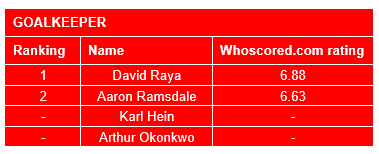


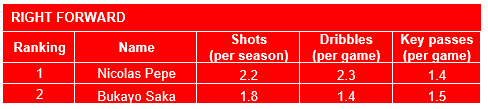

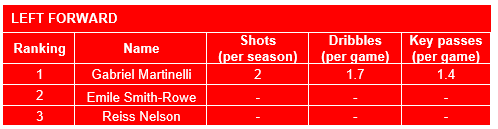
Formation and line-up
Based on:
- the above analytical comparison,
- Arsenal’s aforementioned tactical basis and minimum required KPIs,
- the need to rotate players to maximise playing intensity and minimise injuries, and
- Timber, Zinchenko, Elneny, Lokonga, Jesus and Balogun recovering from injury,
the 11 players which should comprise Arsenal’s starting 11, for their Premier League clash vs Crystal Palace would appear to be as follows:

Freddie08
 My Arsenal FC