My Arsenal FC
A blog about all things Arsenal
Arsenal Player Analysis: Premier League Round 5
Following each season of the Premier League, each Arsenal player’s career-to-date performances are analysed and ranked against their internal competition.
Methodology
In assessing the on-field production and the comparative ranking of each player which comprise Arsenal’s senior squad, each player is allocated into six positional categories (with some players allocated to multiple positional categories due to their perceived versatility).
Those positional categories consist of:
- Goalkeeper
- Defenders
- Central Midfielders
- Wide Midfielders
- Inside Forwards
- Centre Forwards
Once categorised, each player’s output in defined key performance indicators (KPIs) for their respective positional category has then been considered, using data sourced from Whoscored.com.
To provide a realistic picture of each individual player’s on-field production, only data from those seasons, throughout the player’s professional career, where the player has started at least 15 league games in at least two seasons (consecutive or non-consecutive) was considered. Where a player has not met that criteria, their productivity data was not assessed.
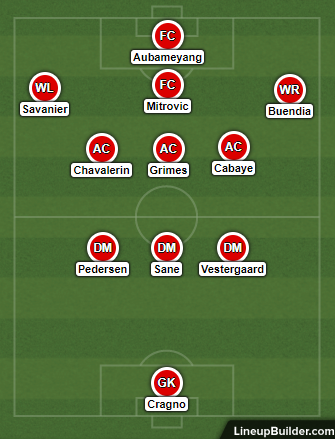
Different weightings were then assigned to the KPI data considered for each positional group based on the assumption that Arsenal adopt a 3-4-2-1 formation and the cornerstones of Arsenal’s tactical approach is as follows:
- Defend by aggressively pressing the opponent.
- Attack through their central and wide-midfielders quickly transitioning the ball forward after recovering it, by dribbling it up the field and playing through passes into the inside forwards and centre forwards as they attack the channels between the oppositions fullbacks and centre backs.
- The goalkeeper’s primary aims are to stop shots and claim crosses.
- The centre backs’ primary aims are to press and tackle their opponent to recover the ball (2+ per game), and win aerial duels (3+ per game).
- The central and wide midfielders’ primary aims are to press and tackle their opponent to recover the ball (2+ per game), and contribute to the team’s offensive play by producing multiple dribbles (1+) and key passes (1+) per match.
- The inside forwards’ primary aims are to contribute to the team’s offensive play in the final third through multiple shots (3+) and dribbles (2+) per match as well as goals (15+ per season).
- The centre forward’s primary aims are to contribute to the team’s offensive play in the final third through multiple shots (3+) and successful aerial duels (3+) per match as well as goals (15+ per season)
The findings of the aforementioned analysis, provide an invaluable insight as to:
- how each player ranks against their internal competition within their positional category; and
- which 11 players make up Arsenal’s most productive team.
Internal player rankings
The player rankings by position are as follows:
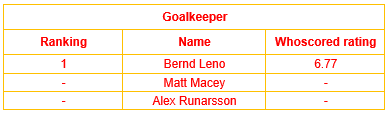

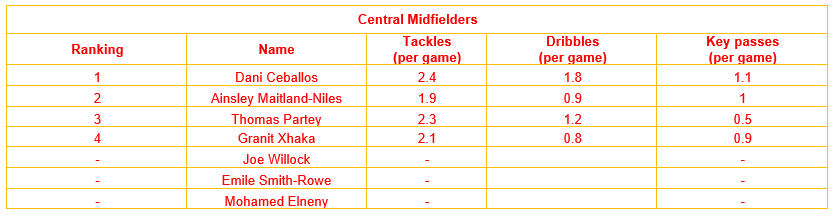
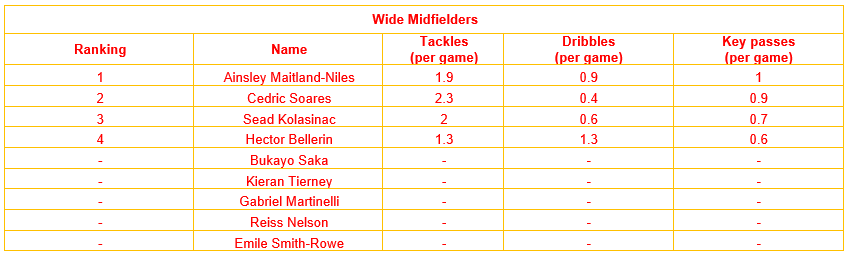


Formation and line-up
Based on:
- the above analytical comparison
- Arsenal’s aforementioned tactical basis and minimum required KPIs
- Mustafi, Chambers, Mari, Sokratis, Emile-Smith Rowe, and Martinelli recovering from injuries
- Arsenal playing 3 matches between 17 October and 25 October, the easiest of which would appear to be versus Rapid Vienna on 22 October
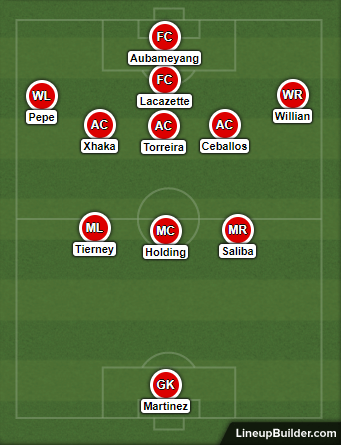
the 11 players which comprise Arsenal’s most productive starting 11, for their round 5 Premier League clash versus Manchester City, would appear to be as follows:

Freddie08
Arsenal Player Analysis: Premier League Round 4
Following each season of the Premier League, each Arsenal player’s career-to-date performances are analysed and ranked against their internal competition.
Methodology
In assessing the on-field production and the comparative ranking of each player which comprise Arsenal’s senior squad, each player is allocated into five positional categories (with some players allocated to multiple positional categories due to their perceived versatility).
Those positional categories consist of:
- Goalkeeper
- Defenders
- Central Midfielders
- Wide Midfielders
- Centre Forward
- Striker
Once categorised, each player’s output in defined key performance indicators (KPIs) for their respective positional category has then been considered, using data sourced from Whoscored.com.
To provide a realistic picture of each individual player’s on-field production, only data from those seasons, throughout the player’s professional career, where the player has started at least 15 league games in at least two seasons (consecutive or non-consecutive) was considered. Where a player has not met that criteria, their productivity data was not assessed.
Different weightings were then assigned to the KPI data considered for each positional group based on the assumption that Arsenal adopt a 3-5-1-1 formation and the cornerstones of Arsenal’s tactical approach is as follows:
- Defend by aggressively pressing the opponent.
- Attack by monopolising possession of the ball in the opposition’s half, and patiently moving the ball back and forth laterally to stretch the opposition’s defensive block, and create passing lanes into the centre forward and striker and/or cut backs and crossing opportunities.
- The goalkeeper’s primary aims are to stop shots and claim crosses.
- The centre backs’ primary aims are to press and tackle their opponent to recover the ball (2+ per game), and win aerial duels (3+ per game).
- The central midfielders’ primary aims are to press and tackle their opponent to recover the ball (2+ per game), and contribute to the team’s offensive play through accurate passing (80%+) and producing multiple key passes (1+) per match.
- The wide midfielders’ primary aims are to press and tackle their opponent to recover the ball (2+ per game) and contribute to the team’s offensive play in the final third through multiple forward dribbles (1+) and multiple key passes per game (1+).
- The centre forward’s primary aims are to contribute to the team’s offensive play in the final third through multiple shots (3+) and successful aerial duels (3+) per match as well as goals (15+ per season)
- The striker’s primary aims are to contribute to the team’s offensive play in the final third through multiple shots (3+) per game and goals (15+ per season).
The findings of the aforementioned analysis, provide an invaluable insight as to:
- how each player ranks against their internal competition within their positional category; and
- which 11 players make up Arsenal’s most productive team.
Internal player rankings
The player rankings by position are as follows:

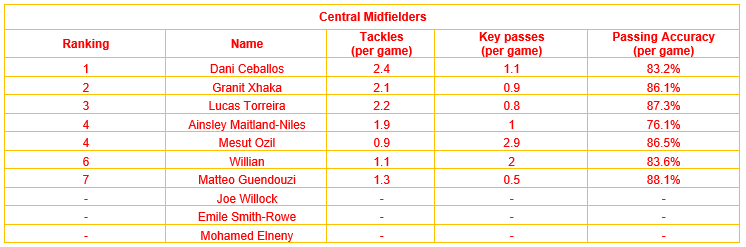


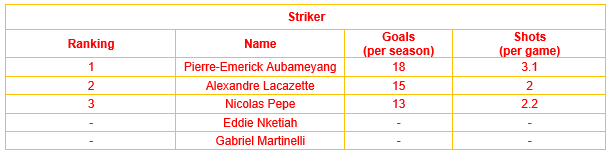
Formation and line-up
Based on:
- the above analytical comparison
- Arsenal’s aforementioned tactical basis and minimum required KPIs
- Mustafi, Chambers, Mari, Sokratis, Emile-Smith Rowe, and Martinelli recovering from injuries
- Arsenal only playing 2 matches between 2 October and 17 October
the 11 players which comprise Arsenal’s most productive starting 11, for their round 4 Premier League clash versus Sheffield Utd, would appear to be as follows:

Freddie08
Arsenal Player Analysis: Carabao Cup Round 4
Following each season of the Premier League, each Arsenal player’s career-to-date performances are analysed and ranked against their internal competition.
Methodology
In assessing the on-field production and the comparative ranking of each player which comprise Arsenal’s senior squad, each player is allocated into five positional categories (with some players allocated to multiple positional categories due to their perceived versatility).
Those positional categories consist of:
- Goalkeeper
- Defenders
- Central Midfielders
- Wide Midfielders
- Centre Forward
- Striker
Once categorised, each player’s output in defined key performance indicators (KPIs) for their respective positional category has then been considered, using data sourced from Whoscored.com.
To provide a realistic picture of each individual player’s on-field production, only data from those seasons, throughout the player’s professional career, where the player has started at least 15 league games in at least two seasons (consecutive or non-consecutive) was considered. Where a player has not met that criteria, their productivity data was not assessed.
Different weightings were then assigned to the KPI data considered for each positional group based on the assumption that Arsenal adopt a 3-5-1-1 formation and the cornerstones of Arsenal’s tactical approach is as follows:
- Defend by aggressively pressing the opponent.
- Attack by monopolising possession of the ball in the opposition’s half, and patiently moving the ball back and forth laterally to stretch the opposition’s defensive block, and create passing lanes into the centre forward and striker and/or cut backs and crossing opportunities.
- The goalkeeper’s primary aims are to stop shots and claim crosses.
- The centre backs’ primary aims are to press and tackle their opponent to recover the ball (2+ per game), and win aerial duels (3+ per game).
- The central midfielders’ primary aims are to press and tackle their opponent to recover the ball (2+ per game), and contribute to the team’s offensive play through accurate passing (80%+) and producing multiple key passes (1+) per match.
- The wide midfielders’ primary aims are to press and tackle their opponent to recover the ball (2+ per game) and contribute to the team’s offensive play in the final third through multiple forward dribbles (1+) and multiple key passes per game (1+).
- The centre forward’s primary aims are to contribute to the team’s offensive play in the final third through multiple shots (3+) and successful aerial duels (3+) per match as well as goals (15+ per season)
- The striker’s primary aims are to contribute to the team’s offensive play in the final third through multiple shots (3+) per game and goals (15+ per season).
The findings of the aforementioned analysis, provide an invaluable insight as to:
- how each player ranks against their internal competition within their positional category; and
- which 11 players make up Arsenal’s most productive team.
Internal player rankings
The player rankings by position are as follows:
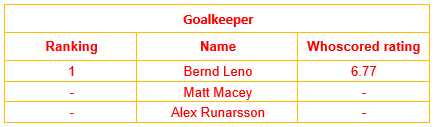

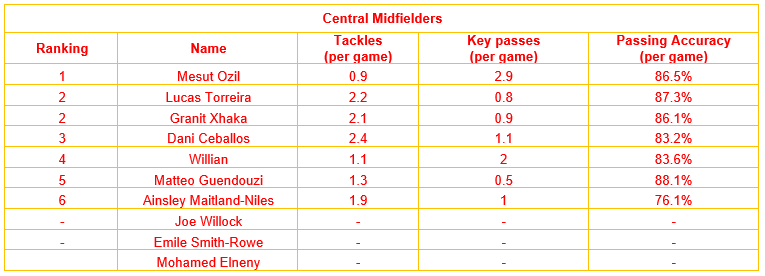


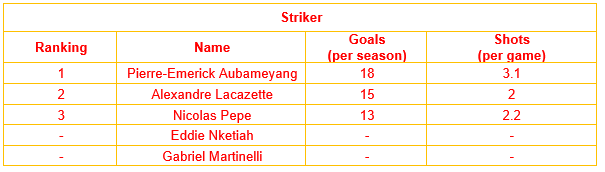
Formation and line-up
Based on:
- the above analytical comparison
- Arsenal’s aforementioned tactical basis and minimum required KPIs
- Mustafi, Chambers, Mari, Sokratis, Emile-Smith Rowe, and Martinelli recovering from injuries
- Arsenal only playing 2 matches between 2 October and 17 October
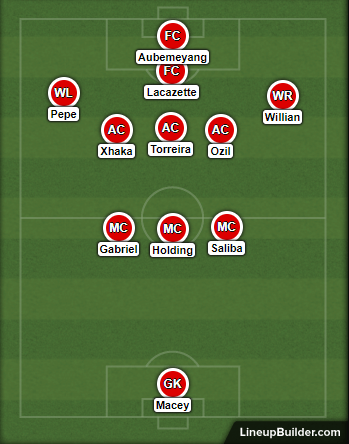
the 11 players which comprise Arsenal’s most productive starting 11, for their round 4 Carabao Cup clash versus Liverpool, would appear to be as follows:
Freddie08
Arsenal Player Analysis: Premier League Round 3
Following each season of the Premier League, each Arsenal player’s career-to-date performances are analysed and ranked against their internal competition.
Methodology
In assessing the on-field production and the comparative ranking of each player which comprise Arsenal’s senior squad, each player is allocated into five positional categories (with some players allocated to multiple positional categories due to their perceived versatility).
Those positional categories consist of:
- Goalkeeper
- Defenders
- Central Midfielders
- Wide Midfielders
- Centre Forward
- Striker
Once categorised, each player’s output in defined key performance indicators (KPIs) for their respective positional category has then been considered, using data sourced from Whoscored.com.
To provide a realistic picture of each individual player’s on-field production, only data from those seasons, throughout the player’s professional career, where the player has started at least 15 league games in at least two seasons (consecutive or non-consecutive) was considered. Where a player has not met that criteria, their productivity data was not assessed.
Different weightings were then assigned to the KPI data considered for each positional group based on the assumption that Arsenal adopt a 3-5-1-1 formation and the cornerstones of Arsenal’s tactical approach is as follows:
- Defend by aggressively pressing the opponent.
- Attack by monopolising possession of the ball in the opposition’s half, and patiently moving the ball back and forth laterally to stretch the opposition’s defensive block, and create passing lanes into the centre forward and striker and/or cut backs and crossing opportunities.
- The goalkeeper’s primary aims are to stop shots and claim crosses.
- The centre backs’ primary aims are to press and tackle their opponent to recover the ball (2+ per game), and win aerial duels (3+ per game).
- The central midfielders’ primary aims are to press and tackle their opponent to recover the ball (2+ per game), and contribute to the team’s offensive play through accurate passing (80%+) and producing multiple key passes (1+) per match.
- The wide midfielders’ primary aims are to press and tackle their opponent to recover the ball (2+ per game) and contribute to the team’s offensive play in the final third through multiple forward dribbles (1+) and multiple key passes per game (1+).
- The centre forward’s primary aims are to contribute to the team’s offensive play in the final third through multiple shots (3+) and successful aerial duels (3+) per match as well as goals (15+ per season)
- The striker’s primary aims are to contribute to the team’s offensive play in the final third through multiple shots (3+) per game and goals (15+ per season).
The findings of the aforementioned analysis, provide an invaluable insight as to:
- how each player ranks against their internal competition within their positional category; and
- which 11 players make up Arsenal’s most productive team.
Internal player rankings
The player rankings by position are as follows:
Formation and line-up
Based on:
- the above analytical comparison
- Arsenal’s aforementioned tactical basis and minimum required KPIs
- Tierney, Mustafi, Chambers, Mari, Sokratis, Soares, Emile-Smith Rowe, and Martinelli recovering from injuries
- Arsenal have already played West Ham and Leicester within the last nine days
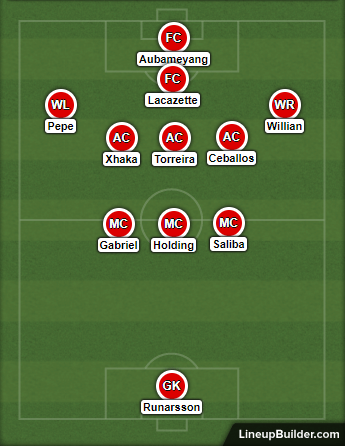
11 players which comprise Arsenal’s most productive starting 11, for their round 3 Premier League clash versus Liverpool, would appear to be as follows:
Freddie08
Arsenal Player Analysis: Carabao Cup 3rd Round
Following each season of the Premier League, each Arsenal player’s career-to-date performances are analysed and ranked against their internal competition.
Methodology
In assessing the on-field production and the comparative ranking of each player which comprise Arsenal’s senior squad, each player is allocated into five positional categories (with some players allocated to multiple positional categories due to their perceived versatility).
Those positional categories consist of:
- Goalkeeper
- Defenders
- Central Midfielders
- Wide Midfielders
- Centre Forward
- Striker
Once categorised, each player’s output in defined key performance indicators (KPIs) for their respective positional category has then been considered, using data sourced from Whoscored.com.
To provide a realistic picture of each individual player’s on-field production, only data from those seasons, throughout the player’s professional career, where the player has started at least 15 league games in at least two seasons (consecutive or non-consecutive) was considered. Where a player has not met that criteria, their productivity data was not assessed.
Different weightings were then assigned to the KPI data considered for each positional group based on the assumption that Arsenal adopt a 3-5-1-1 formation and the cornerstones of Arsenal’s tactical approach is as follows:
- Defend by aggressively pressing the opponent.
- Attack by monopolising possession of the ball in the opposition’s half, and patiently moving the ball back and forth laterally to stretch the opposition’s defensive block, and create passing lanes into the centre forward and striker and/or cut backs and crossing opportunities.
- The goalkeeper’s primary aims are to stop shots and claim crosses.
- The centre backs’ primary aims are to press and tackle their opponent to recover the ball (2+ per game), and win aerial duels (3+ per game).
- The central midfielders’ primary aims are to press and tackle their opponent to recover the ball (2+ per game), and contribute to the team’s offensive play through accurate passing (80%+) and producing multiple key passes (1+) per match.
- The wide midfielders’ primary aims are to press and tackle their opponent to recover the ball (2+ per game) and contribute to the team’s offensive play in the final third through multiple forward dribbles (1+) and multiple key passes per game (1+).
- The centre forward’s primary aims are to contribute to the team’s offensive play in the final third through multiple shots (3+) and successful aerial duels (3+) per match as well as goals (15+ per season)
- The striker’s primary aims are to contribute to the team’s offensive play in the final third through multiple shots (3+) per game and goals (15+ per season).
The findings of the aforementioned analysis, provide an invaluable insight as to:
- how each player ranks against their internal competition within their positional category; and
- which 11 players make up Arsenal’s most productive team.
Internal player rankings
The player rankings by position are as follows:
Formation and line-up
Based on:
- the above analytical comparison
- Arsenal’s aforementioned tactical basis and minimum required KPIs
- Tierney, Mustafi, Chambers, Mari, Sokratis, Soares, Emile-Smith Rowe, and Martinelli recovering from injuries
- Arsenal have already played West Ham and due to also play Liverpool all within a nine day period
11 players which comprise Arsenal’s most productive starting 11, for their round 3 Carabao Cup clash versus Leicester, would appear to be as follows:
Freddie08
ARSENAL PLAYER ANALYSIS: ROUND 2 TEAM SELECTION
Following each season of the Premier League, each Arsenal player’s career-to-date performances are analysed and ranked against their internal competition.
Methodology
In assessing the on-field production and the comparative ranking of each player which comprise Arsenal’s senior squad, each player is allocated into five positional categories (with some players allocated to multiple positional categories due to their perceived versatility).
Those positional categories consist of:
- Goalkeeper
- Defenders
- Central Midfielders
- Wide Midfielders
- Centre Forward
- Striker
Once categorised, each player’s output in defined key performance indicators (KPIs) for their respective positional category has then been considered, using data sourced from Whoscored.com.
To provide a realistic picture of each individual player’s on-field production, only data from those seasons, throughout the player’s professional career, where the player has started at least 15 league games in at least two seasons (consecutive or non-consecutive) was considered. Where a player has not met that criteria, their productivity data was not assessed.
Different weightings were then assigned to the KPI data considered for each positional group based on the assumption that Arsenal adopt a 3-5-1-1 formation and the cornerstones of Arsenal’s tactical approach is as follows:
- Defend by aggressively pressing the opponent.
- Attack by monopolising possession of the ball in the opposition’s half, and patiently moving the ball back and forth laterally to stretch the opposition’s defensive block, and create passing lanes into the centre forward and striker and/or cut backs and crossing opportunities.
- The goalkeeper’s primary aims are to stop shots and claim crosses.
- The centre backs’ primary aims are to press and tackle their opponent to recover the ball (2+ per game), and win aerial duels (3+ per game).
- The central midfielders’ primary aims are to press and tackle their opponent to recover the ball (2+ per game), and contribute to the team’s offensive play through accurate passing (80%+) and producing multiple key passes (1+) per match.
- The wide midfielders’ primary aims are to press and tackle their opponent to recover the ball (2+ per game) and contribute to the team’s offensive play in the final third through multiple forward dribbles (1+) and multiple key passes per game (1+).
- The centre forward’s primary aims are to contribute to the team’s offensive play in the final third through multiple shots (3+) and successful aerial duels (3+) per match as well as goals (15+ per season)
- The striker’s primary aims are to contribute to the team’s offensive play in the final third through multiple shots (3+) per game and goals (15+ per season).
The findings of the aforementioned analysis, provide an invaluable insight as to:
- how each player ranks against their internal competition within their positional category; and
- which 11 players make up Arsenal’s most productive team.
Internal player rankings
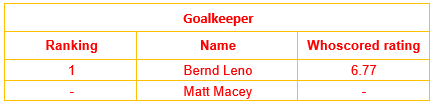
The player rankings by position are as follows:
Formation and line-up
Based on:
- the above analytical comparison
- Arsenal’s aforementioned tactical basis and minimum required KPIs
- Mustafi, Chambers, Mari, Sokratis, Emile-Smith Rowe, and Martinelli recovering from injuries
- Arsenal also playing Leicester and Liverpool in the next nine days
11 players which comprise Arsenal’s most productive starting 11, for their round 2 clash versus West Ham, would appear to be as follows:

Freddie08
Arsenal Player Analysis: Round 1 Team Selection
Following each season of the Premier League, each Arsenal player’s career-to-date performances are analysed and ranked against their internal competition.
Methodology
In assessing the on-field production and the comparative ranking of each player which comprise Arsenal’s senior squad, each player is allocated into five positional categories (with some players allocated to multiple positional categories due to their perceived versatility).
Those positional categories consist of:
- Goalkeeper
- Defenders
- Central Midfielders
- Wide Midfielders
- Centre Forward
- Striker
Once categorised, each player’s output in defined key performance indicators (KPIs) for their respective positional category has then been considered, using data sourced from Whoscored.com.
To provide a realistic picture of each individual player’s on-field production, only data from those seasons, throughout the player’s professional career, where the player has started at least 15 league games in at least two seasons (consecutive or non-consecutive) was considered. Where a player has not met that criteria, their productivity data was not assessed.
Different weightings were then assigned to the KPI data considered for each positional group based on the assumption that Arsenal adopt a 3-5-1-1 formation and the cornerstones of Arsenal’s tactical approach is as follows:
- Defend by aggressively pressing the opponent.
- Attack by monopolising possession of the ball in the opposition’s half, and patiently moving the ball back and forth laterally to stretch the opposition’s defensive block, and create passing lanes into the centre forward and striker and/or cut backs and crossing opportunities.
- The goalkeeper’s primary aims are to stop shots and claim crosses.
- The centre backs’ primary aims are to press and tackle their opponent to recover the ball (2+ per game), and win aerial duels (3+ per game).
- The central midfielders’ primary aims are to press and tackle their opponent to recover the ball (2+ per game), and contribute to the team’s offensive play through accurate passing (80%+) and producing multiple key passes (1+) per match.
- The wide midfielders’ primary aims are to press and tackle their opponent to recover the ball (2+ per game) and contribute to the team’s offensive play in the final third through multiple forward dribbles (1+) and multiple key passes per game (1+).
- The centre forward’s primary aims are to contribute to the team’s offensive play in the final third through multiple shots (3+) and successful aerial duels (3+) per match as well as goals (15+ per season)
- The striker’s primary aims are to contribute to the team’s offensive play in the final third through multiple shots (3+) per game and goals (15+ per season).
The findings of the aforementioned analysis, provide an invaluable insight as to:
- how each player ranks against their internal competition within their positional category; and
- which 11 players make up Arsenal’s most productive team.
Internal player rankings
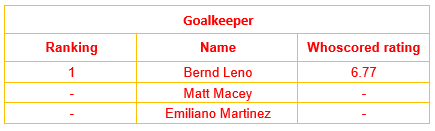
The player rankings by position are as follows:
Formation and line-up
Based on the above analytical comparison, Arsenal’s aforementioned tactical basis and minimum required KPIs, and with Mustafi, Chambers, Mari, Luiz, Sokratis, Emile-Smith Rowe, and Martinelli recovering from injuries, the 11 players which comprise Arsenal’s most productive starting 11, for their round 1 clash versus Fulham, would appear to be as follows:
Freddie08
2020/2021 SEASON : WHICH PLAYERS ARSENAL SHOULD RETAIN, SELL AND RECRUIT TO FIT A 3-5-1-1 FORMATION
With Arsenal’s 2019/2020 Premier League campaign over, the team finishing a disappointing 8th in the Premier League (but qualifying for the Europa League via their FA Cup triumph) and the adjusted Summer transfer window now open, it’s an opportune time to examine the on-field production of each player in Arsenal’s senior squad, and the player market, in order to identify:
- which players Arsenal should sell
- which players Arsenal should recruit
- which players Arsenal should retain.
Methodology
In assessing the on-field production and the comparative ranking of each player which comprise Arsenal’s senior squad, each player is allocated into five positional categories (with some players allocated to multiple positional categories due to their perceived versatility).
Those positional categories consist of:
- Goalkeeper
- Defenders
- Central Midfielders
- Wide Midfielders
- Centre Forward
- Striker
Once categorised, each player’s output in defined key performance indicators (KPIs) for their respective positional category has then been considered, using data sourced from Whoscored.com.
To provide a realistic picture of each individual player’s on-field production, only data from those seasons, throughout the player’s professional career, where the player has started at least 15 league games in at least two seasons (consecutive or non-consecutive) was considered. Where a player has not met that criteria, their productivity data was not assessed.
Different weightings were then assigned to the KPI data considered for each positional group based on the assumption that Arsenal adopt a 3-5-1-1 formation and the cornerstones of Arsenal’s tactical approach is as follows:
- Defend by aggressively pressing the opponent.
- Attack by monopolising possession of the ball in the opposition’s half, and patiently moving the ball back and forth laterally to stretch the opposition’s defensive block, and create passing lanes into the centre forward and striker and/or cut backs and crossing opportunities.
- The goalkeeper’s primary aims are to stop shots and claim crosses.
- The centre backs’ primary aims are to press and tackle their opponent to recover the ball, and win aerial duels.
- The central midfielders’ primary aims are to press and tackle their opponent to recover the ball, and contribute to the team’s offensive play through accurate passing and producing multiple key passes per match.
- The wide midfielders’ primary aims are to press and tackle their opponent to recover the ball and contribute to the team’s offensive play in the final third through multiple forward dribbles and multiple key passes per game.
- The centre forward’s primary aims are to contribute to the team’s offensive play in the final third through multiple shots and successful aerial duels per match as well as goals
- The striker’s primary aims are to contribute to the team’s offensive play in the final third through multiple shots per game and goals.
Once the relative on field productivity of Arsenal’s current senior squad was assessed, the comparative KPI data (from Whoscored.com) of the players competing in the following leagues was then reviewed:
- English Premier League
- Championship
- Serie A
- Ligue 1
- La Liga
- Bundesliga
When considering players competing in the aforementioned leagues, those players in clubs who are due to compete in the 2020/21 Champions League, were not considered. This included clubs such as Chelsea, Manchester City, Manchester United, Liverpool, Barcelona, Real Madrid, Atletico Madrid, Sevilla, Bayern Munich, Borussia Dortmund, RB Leipzig, Borussia Monchenglabach. PSG, Marseille, Rennes, Juventus, Inter Milan, Atalanta, and Lazio. This was designed to realistically account for Arsenal’s attractiveness as a prospective employer, based on the club’s current standing in European football (as a Europa League competitor).
Also, only players from the aforementioned leagues who have, during their professional career, started at least 15 league games in at least two seasons (consecutive or non-consecutive) were considered. Where a player has not met that criteria, their productivity data was not assessed. Again, this was designed to provide a realistic picture of each individual player’s on-field production.
The KPI data of the reviewed players was then contrasted against the KPI data of the players who currently comprise Arsenal’s senior squad, to identify prospective transfer targets.
Player rankings

Starting with the goalkeeping position, and while it’s unfair to judge Macey or Martinez’ suitability, as neither player has sufficient professional experience to appropriately assess their performances, it is fair to say that Bernd Leno, has delivered less impressive performances throughout his career to date, in contrast to the likes of Alessio Cragno of Cagliari.
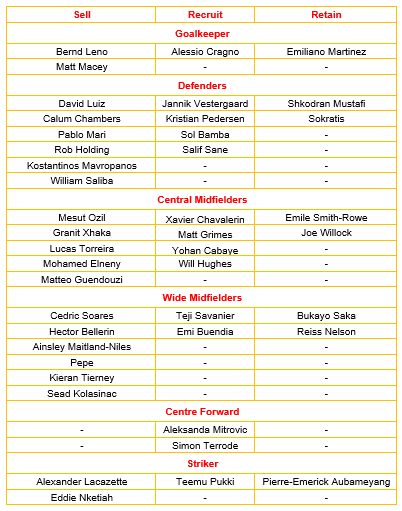
In light of that, it would be logical for Arsenal to sell Leno, and recruit Cragno, to serve as one of the club’s two senior goalkeepers.
In terms of the second of those two senior goalkeepers, with Martinez and Macey unproven but both considered ‘homegrown’, and likely to see limited game time, it would be logical for the club to retain either one of Martinez or Macey as the club’s second senior goalkeeper. My preference would be Martinez.

As for the club’s contracted centre back options, Arsenal fortunately have two players in Mustafi and Sokratis, who can legitimately lay claim to having a sufficiently productive performance record to warrant selection as two of the club’s six senior centre backs.
As for the club’s other centre back options, while its unfair to judge Mavropanos, Holding, Saliba or Tierney, as all four players have insufficient professional experience in any of the considered leagues, to appropriately assess their performances, Luiz, Chambers and Kolasinac’s propensity to win aerial duels are inferior to a number of the players reviewed, and Luiz and Mari’s tackles per game records are similarly inferior.
Needless to say, Mustafi and Sokratis aside, Arsenal lack a sufficient number of adequately productive centre back options.
That being the case, it would be logical for Arsenal to sell Luiz, Chambers, Kolasinac and Mari, and recruit one of Jannik Vestergaard of Southampton, Kristian Pedersen of Birmingham, Sol Bamba of Cardiff or Salif Sane of Schalke, to serve alongside Mustafi and Sokratis as three of the club’s six senior central defenders.
In terms of the fourth, fifth and sixth centre backs, given the critical nature of defence, there is a strong argument that Arsenal should aim to recruit the next most productive centre backs available to fill those senior centre back roles. That being the case, Arsenal should sell Holding, Mavropanos and Saliba and recruit three of the following players:
- Jannik Vestergaard of Southampton
- Kristian Pedersen of Birmingham
- Salif Sane of Schalke
- Sol Bamba of Cardiff.
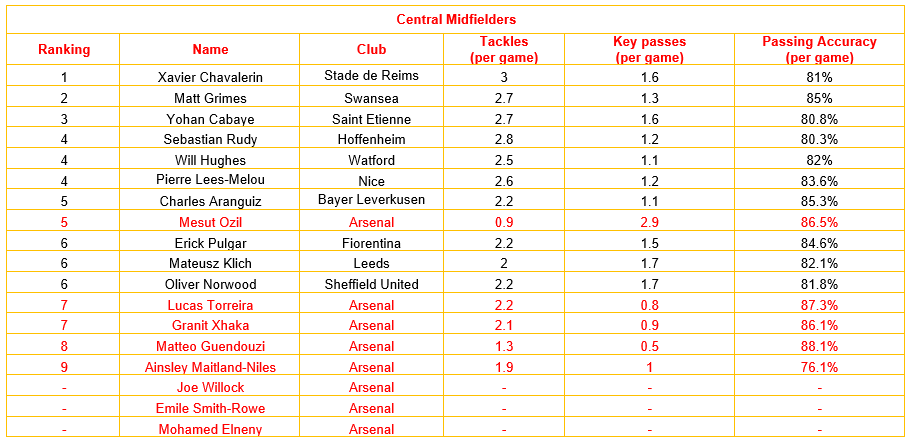
In terms of the club’s contracted central midfield options, it’s unfair to judge Smith-Rowe, Elneny, and Willock’s suitability, as none of those players have had sufficient professional experience in any of the examined leagues, to appropriately assess their performances.
Regarding Arsenal’s other central midfield options, Torreira, Xhaka, Guendouzi, and Maitland-Niles’ tackles and key passes per match records are inferior to a number of the players reviewed. While Maitland-Niles’ passing accuracy is similarly inferior.
In light of the comparative deficiencies of Arsenal’s currently contracted central midfield options, it would be logical for Arsenal to sell Torreira, Xhaka, Guendouzi, and Maitland-Niles and, recruit the following players to serve as three of Arsenal’s six senior central midfielders:
- Xavier Chavalerin of Stade de Reims
- Matt Grimes of Swansea
- Yohan Cabaye of Saint Etienne
In terms of the club’s fourth, fifth and sixth senior central midfielders, while having highly productive and proven players in the defence is critical, given their function as the last line of protection for Arsenal’s goalkeeper, there is a strong argument that Arsenal have more flexibility to utilise unproven players to fill the remaining central midfield spots. That being the case, and given the Premier League’s homegrown rule, it would be logical for Arsenal to sell Elneny, retain Smith-Rowe, and Willock, and recruit Will Hughes of Watford to fill Arsenal’s fourth, fifth and sixth senior central midfielder roles.
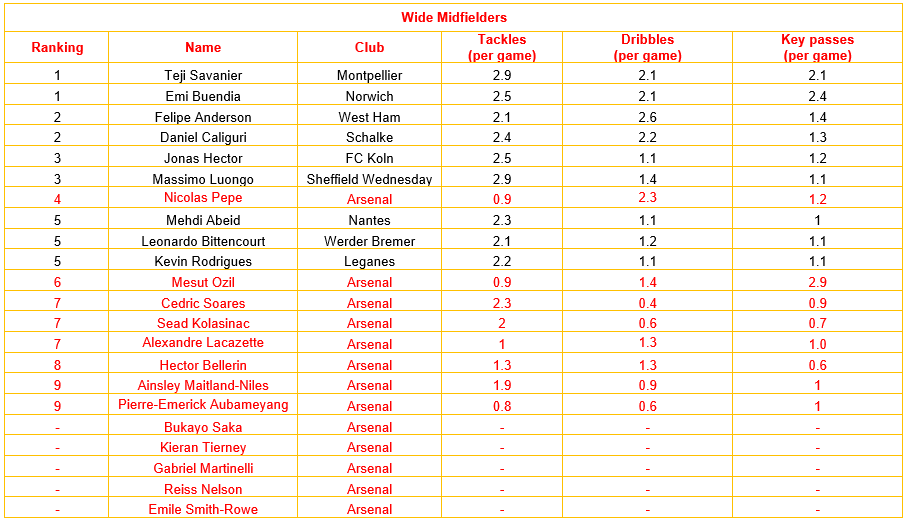
As for the club’s contracted wide midfield options, it’s unfair to judge Smith-Rowe, Saka, Nelson, Tierney or Martinelli’s suitability, as none of those players have had sufficient professional experience in the considered leagues, to appropriately assess their performances.
Regarding Arsenal’s other current wide midfield options, Pepe, Ozil, Lacazette, Aubameyang, Kolasinac, Bellerin and Maitland-Niles’ tackles per game records are inferior to a number of the players reviewed. While Aubameyang, Soares, Kolasinac and Maitland-Niles’ dribbles per match records are similarly inferior, as are Soares, Kolasinac and Bellerin’s key passes per game records.
In light of the comparative deficiencies of Arsenal’s currently contracted wide midfield options, it would be logical for Arsenal to sell Ozil, Maitland-Niles, Bellerin, Kolasinac and Soares, and recruit Teji Savanier of Montpellier and Emi Buendia of Norwich, to serve as two of Arsenal’s four senior wide midfielders.
In terms of the club’s third and fourth senior wide midfielders, as with Arsenal’s central midfielders, there is a strong argument that Arsenal have flexibility to utilise unproven players to fill a number of the wide midfield roles in the squad. That being the case, and given the Premier League’s homegrown rule, it would be logical for Arsenal to sell Martinelli, retain Nelson, and retain one of Saka and Tierney, to serve as the club’s third and fourth senior wide midfielders. Of Saka and Tierney, my preference would be to retain Saka.
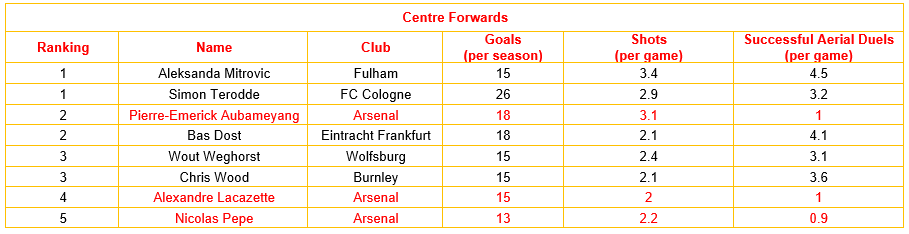
In terms of the club’s contracted centre forward options, Pepe, Lacazette and Aubameyang are all deficient aerially, in contrast to a number of players reviewed.
In light of the comparative deficiency of Arsenal’s currently contracted centre forward options in this KPI, it would be logical for Arsenal to sell Lacazette, Pepe, and recruit Aleksanda Mitrovic of Fulham to serve as one of Arsenal’s two senior centre forwards.
In terms of the second centre forward in the squad, having highly productive and proven players in the centre forward and striker roles is critical, given their primary function is to score the bulk of the side’s goals. That being the case, it would be logical for Arsenal to also recruit Simon Terrode of FC Cologne.
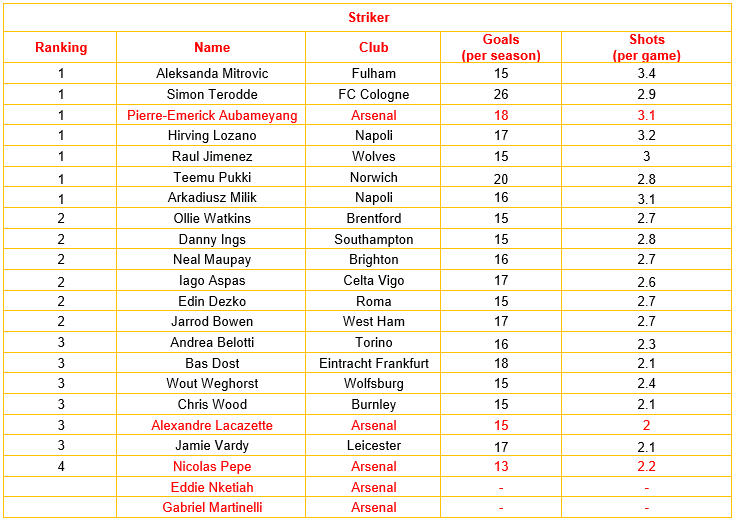
In terms of the club’s contracted striker options, Arsenal fortunately have a player in Aubameyang, who can legitimately lay claim to having a sufficiently productive performance record to warrant selection as one of the club’s two senior strikers.
As for the club’s other striker options, while its unfair to judge Martinelli or Nketiah, as both players have insufficient professional experience in any of the considered leagues, to appropriately assess their performances, Pepe and Lacazette’s records in term of goals per season and shots per game are comparatively inferior to a considerable number of the players reviewed.
In light of that and there being a need to have highly productive and proven players in the striker role, given its primary function is to score the bulk of the side’s goals , it would be logical for Arsenal to sell Lacazette, Pepe, Martinelli and Nketiah, and recruit one of Hirving Lozano of Napoli, Raul Jimenez of Wolves, Teemu Pukki of Norwich or Arkadiusz Milik of Napoli to fill the second of Arsenal’s two senior striker roles. My preference would be Pukki, based on his relative value and experience in the English leagues.
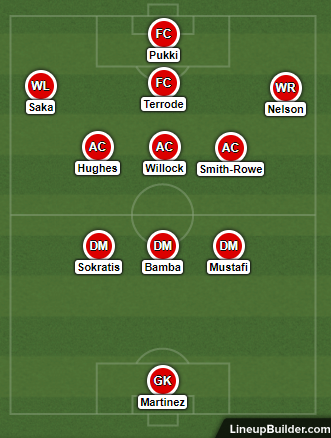
Summary of proposed activity
Freddie08
2020/2021 Season : WHICH PLAYERS ARSENAL SHOULD RETAIN, SELL AND RECRUIT to fit a 3-4-3 Formation
With Arsenal’s 2019/2020 Premier League campaign over, the team finishing a disappointing 8th in the Premier League (but qualifying for the Europa League via their FA Cup triumph) and the adjusted Summer transfer window now open, it’s an opportune time to examine the on-field production of each player in Arsenal’s senior squad, and the player market, in order to identify:
- which players Arsenal should sell
- which players Arsenal should recruit
- which players Arsenal should retain.
Methodology
In assessing the on-field production and the comparative ranking of each player which comprise Arsenal’s senior squad, each player is allocated into five positional categories (with some players allocated to multiple positional categories due to their perceived versatility).
Those positional categories consist of:
- Goalkeeper
- Defenders
- Midfielders
- Wide Forwards
- Centre Forward
Once categorised, each player’s output in defined key performance indicators (KPIs) for their respective positional category has then been considered, using data sourced from Whoscored.com.
To provide a realistic picture of each individual player’s on-field production, only data from those seasons, throughout the player’s professional career, where the player has started at least 15 league games in at least two seasons (consecutive or non-consecutive) was considered. Where a player has not met that criteria, their productivity data was not assessed.
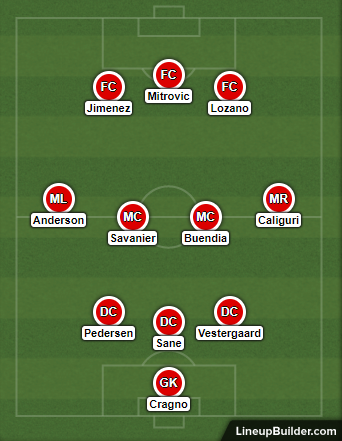
Different weightings were then assigned to the KPI data considered for each positional group based on the assumption that Arsenal adopt a 3-4-3 formation and the cornerstones of Arsenal’s tactical approach is as follows:
- Defend by aggressively pressing the opponent.
- Attack by transitioning the ball quickly forward on turnovers to create higher probability goal scoring opportunities, and create overloads on the flanks to generate cut back and crossing opportunities.
- Arsenal’s goalkeeper’s primary aims are to stop shots and claim crosses.
- Arsenal’s centre backs’ primary aims are to press and tackle their opponent to recover the ball, and win aerial duels.
- Arsenal’s midfielders’ primary aims are to press and tackle their opponent to recover the ball, and contribute to the team’s offensive transitional play through multiple forward dribbles and key passes per match.
- Arsenal’s wide forwards’ primary aims are to contribute to the team’s offensive play in the final third through multiple forward dribbles in the inside channels and shots per game as well as goals.
- Arsenal’s centre forward’s primary aims are contribute to the team’s offensive play in the final third through multiple shots and successful aerial duels per match as well as goals.
Once the relative on field productivity of Arsenal’s current senior squad was assessed, the comparative KPI data (from Whoscored.com) of the players competing in the following leagues was then reviewed:
- English Premier League
- Championship
- Serie A
- Ligue 1
- La Liga
- Bundesliga
When considering players competing in the aforementioned leagues, those players in clubs who are due to compete in the 2020/21 Champions League, were not considered. This included clubs such as Chelsea, Manchester City, Manchester United, Liverpool, Barcelona, Real Madrid, Atletico Madrid, Sevilla, Bayern Munich, Borussia Dortmund, RB Leipzig, Borussia Monchenglabach. PSG, Marseille, Rennes, Juventus, Inter Milan, Atalanta, and Lazio. This was designed to realistically account for Arsenal’s attractiveness as a prospective employer, based on the club’s current standing in European football (as a Europa League competitor).
Also, only players from the aforementioned leagues who have, during their professional career, started at least 15 league games in at least two seasons (consecutive or non-consecutive) were considered. Where a player has not met that criteria, their productivity data was not assessed. Again, this was designed to provide a realistic picture of each individual player’s on-field production.
The KPI data of the reviewed players was then contrasted against the KPI data of the players who currently comprise Arsenal’s senior squad, to identify prospective transfer targets.
Player rankings
Starting with the goalkeeping position, and while it’s unfair to judge Macey or Martinez’ suitability, as neither player has sufficient professional experience to appropriately assess their performances, it is fair to say that Bernd Leno, has delivered less impressive performances throughout his career to date, in contrast to the likes of Alessio Cragno of Cagliari.
In light of that, it would be logical for Arsenal to sell Leno, and recruit Cragno, to serve as one of the club’s two senior goalkeepers.
In terms of the second of those two senior goalkeepers, with Martinez and Macey unproven but both considered ‘homegrown’, and likely to see limited game time, it would be logical for the club to retain either one of Martinez or Macey as the club’s second senior goalkeeper. My preference would be Martinez.
As for the club’s contracted centre back options, Arsenal fortunately have two players in Mustafi and Sokratis, who can legitimately lay claim to having a sufficiently productive performance record to warrant selection as two of the club’s six senior centre backs.
As for the club’s other centre back options, its unfair to judge Mavropanos, Holding, Saliba or Tierney, as all four players have insufficient professional experience in any of the considered leagues, to appropriately assess their performances.
As for Arsenal’s other existing centre back options:
- Luiz, Chambers and Kolasinac’s propensity to win aerial duels is inferior to a number of the players reviewed
- Luiz and Mari’s tackles per game record is similarly inferior to a number of the players reviewed.
Needless to say, Mustafi and Sokratis aside, Arsenal lack a sufficient number of adequately productive centre back options.
That being the case, it would be logical for Arsenal to sell Luiz, Chambers, Kolasinac and Mari, at a minimum, and recruit one of Jannik Vestergaard of Southampton, Kristian Pedersen of Birmingham, Sol Bamba of Cardiff or Salif Sane of Schalke, to serve alongside Mustafi and Sokratis as three of the club’s six senior central defenders.
In terms of the fourth, fifth and sixth centre backs, given the critical nature of defence, there is a strong argument that Arsenal should aim to recruit the next most productive centre backs available to fill those senior centre back roles. That being the case, Arsenal should sell Holding, Mavropanos and Saliba and recruit three of the following players:
- Jannik Vestergaard of Southampton
- Kristian Pedersen of Birmingham
- Salif Sane of Schalke
- Sol Bamba of Cardiff.

In terms of the club’s contracted midfield options, it’s unfair to judge Smith-Rowe, Elneny, Willock, Nelson, Martinelli, Tierney and Saka’s suitability, as none of those players have had sufficient professional experience in any of the examined leagues, to appropriately assess their performances.
Regarding Arsenal’s other midfield options:
- Soares, Torreira, Kolasinac and Xhaka’s dribbles and key passes per match record is inferior to a number of the players reviewed
- Bellerin, Maitland-Niles and Guendouzi’s tackles per game record Is similarly inferior in contrast to the players reviewed, as is Bellerin and Guendouzi’s key passes per match record and Maitland-Niles and Guendouzi’s dribbles per game record.
In light of the comparative deficiencies of Arsenal’s currently contracted midfield options, it would be logical for Arsenal to sell Soares, Torreira, Kolasinac, Xhaka, Bellerin, Maitland-Niles and Guendouzi, and at a minimum, recruit the following players to serve as four of Arsenal’s eight senior midfielders:
- Teji Savanier of Montpellier
- Emi Buendia of Norwich
- Felipe Anderson of West Ham
- Daniel Caliguri of Schalke
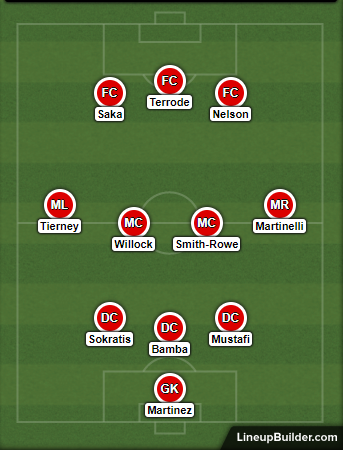
In terms of the club’s fifth, sixth, seventh and eighth senior midfielders, while having highly productive and proven players in the defence is critical, given their function as the last line of protection for Arsenal’s goalkeeper, there is a strong argument that Arsenal have more flexibility to utilise unproven players to fill the fifth, sixth, seventh and eighth midfield roles. That being the case, and given the Premier League’s homegrown rule, it would be logical for Arsenal to sell Elneny and retain four of Smith-Rowe, Willock, Nelson, Martinelli, Tierney and Saka, as the club’s fifth, sixth, seventh and eighth senior midfielders. My preference would be to retain Martinelli, Smith Rowe, Willock and Tierney in these roles.
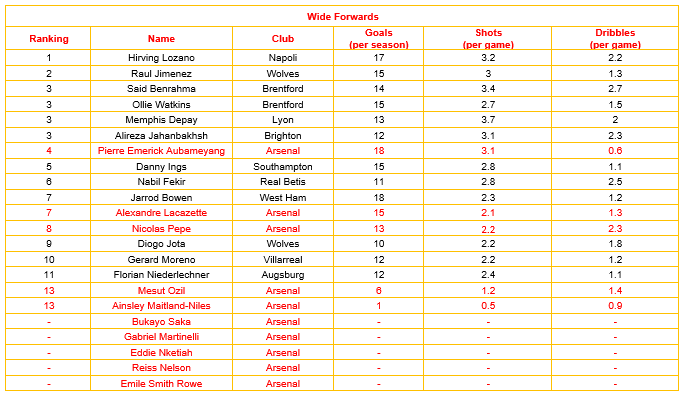
As for the club’s contracted wide forward options, it’s unfair to judge Smith-Rowe, Saka, Nelson, Nketiah or Martinelli’s suitability, as none of those players have had sufficient professional experience in the considered leagues, to appropriately assess their performances.
Regarding Arsenal’s other current wide forward options:
- Maitland-Niles goals per season record, and shots and successful forward dribbles per match record are inferior to a number of the players reviewed
- Ozil and Pepe’s goals per season record is similarly inferior, as are their propensity to shoot per game
- Lacazette’s shots and dribbles per match record is also inferior to a number of the players reviewed
- Aubameyang’s dribbles per game record is inferior In contrast to a number of the players reviewed.
In light of the comparative deficiencies of Arsenal’s currently contracted wide forward options, it would be logical for Arsenal to sell Maitland-Niles, Pepe, Ozil, Lacazette, and Aubameyang, and recruit Hirving Lozano of Napoli and Raul Jimenez of Wolves, to serve as two of Arsenal’s four senior wide forwards.
In terms of the club’s third and fourth senior wide forwards, while having highly productive and proven players in the centre forward role is critical, given their primary function is to score the bulk of the side’s goals, there is a strong argument that Arsenal have more flexibility to utilise unproven players to fill the backup wide forward roles. That being the case, and given the Premier League’s homegrown rule, it would be logical for Arsenal to retain two of Saka, Nelson, and Nketiah, to serve as the club’s third and fourth senior wide forwards. My preference would be to retain Saka and Nelson in the roles

In terms of the club’s contracted centre forward options, while it’s unfair to judge Nkeitah, and Martinelli’s suitability, as neither of those players have sufficient professional experience, in the considered leagues, to appropriately assess their performances, regarding the club’s other centre forward options:
- Pepe and Lacazette’s goals per season and shots and successful aerial duels per match records are inferior in contrast to a number of players reviewed
- Aubameyang’s successful aerial duels per game record is also inferior.
In light of the comparative deficiencies of Arsenal’s currently contracted centre forward options, it would be logical for Arsenal to sell Lacazette, Pepe and Aubameyang, at a minimum, and recruit Aleksanda Mitrovic of Fulham to serve as one of Arsenal’s two senior centre forwards.
In terms of the second centre forward, having highly productive and proven players in the striking roles is critical, given their primary function is to score the bulk of the side’s goals. That being the case, it would be logical for Arsenal to sell Nketiah, and recruit Simon Terrode of FC Cologne.
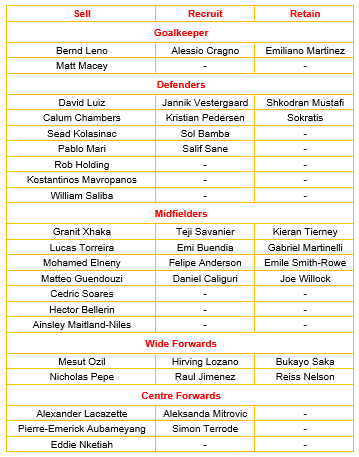
Summary of proposed activity
Freddie08
Arsenal Player Analysis: Round 23 Player Analysis and Round 24 Team Selection
Following each round of the Premier League, each Arsenal player’s season-to-date performance is analysed and ranked against their internal competition.
In assessing the respective players’ on field production and their comparative internal rankings, each player is allocated into eight positional categories (with some players allocated to multiple positional categories due to their perceived versatility).
Those positional categories consist of:
- Goalkeeper,
- Right fullback,
- Centre back,
- Left fullback,
- Defensive midfield,
- Centre midfield,
- Attacking midfield, and
- Striker.
Once categorised, each player’s output in defined key performance indicators (KPIs) for their respective positional category has then been considered, using data sourced from Whoscored.com.
Different weightings are then assigned to the KPI data considered for each positional group based on the assumption that the cornerstones of Arsenal’s tactical approach is as follows:
- Defensively: press the opponent when they are in their own half, and then when the ball transitions into Arsenal’s half, establish and maintain compactness by adopting a medium block, position focused pressing game, in which the forwards and midfielders prioritise retention of shape, and only press the ball when it goes out to an opposition fullback or when a centre back pushes forwards.
- Offensively: transition the ball quickly forward on turnovers to create higher probability goal scoring opportunities, and create overloads on the flanks to generate cut back opportunities.
- Arsenal’s goalkeeper’s primary aims is to stop shots and claim crosses.
- Arsenal’s centre backs’ primary aims are to recover the ball from their opponent (tackles and interceptions), win aerial duels, clear the ball from danger and block shots.
- Arsenal’s fullbacks’ primary aims are to recover the ball from their opponent (tackles and interceptions), execute multiple key passes during a match (with the intent of providing assists), and contribute to the team’s offensive transitional play through multiple forward dribbles per match.
- Arsenal’s defensive midfielders’ primary aims are to recover the ball from their opponent (tackles and interceptions), and contribute to the team’s offensive transitional play through accurate passing, and multiple long range passes per match.
- Arsenal’s central midfielders’ primary aims are to recover the ball from their opponent (tackles and interceptions), and contribute to the team’s offensive transitional play through accurate passing, and multiple forward dribbles per match.
- Arsenal’s attacking midfielders’ primary aims are to provide assists, score goals, create goal scoring opportunities through multiple key passes, and multiple forward dribbles per match.
- Arsenal’s strikers’ primary aims are to score goals, and record multiple shots and successful aerial duels per match.
The findings of the aforementioned analysis, provide an invaluable insight as to:
- how each player ranks against their internal competition within their positional category; and
- which 11 players make up Arsenal’s most productive team.
Internal player rankings
Following Round 23 of the Premier League, the player rankings are as follows:


Formation and line-up
Based on the above analytical comparison, Arsenal’s aforementioned tactical basis, and with Bellerin, Chambers, Tierney and Torreira recovering from injuries and Aubameyang suspended, the 11 players which comprise Arsenal’s most productive starting 11, for their round 24 clash versus Chelsea, would appear to be as follows:


Freddie08
 My Arsenal FC